

How AI Works
AI learns, predicts and generates content.
- AI learns by studying examples (data) to recognize patterns, much like how people learn by exploring concepts, practicing and observing the world around them.
- AI predicts by using what it’s learned to answer questions, provide suggestions or even create new content.
- AI generates new content (text, images, code, etc.).
Simply put, AI doesn’t "think" like humans—it learns from data, predicts what makes sense based on its training and generates new content by identifying patterns in vast amounts of information.
Differences in AI
Image
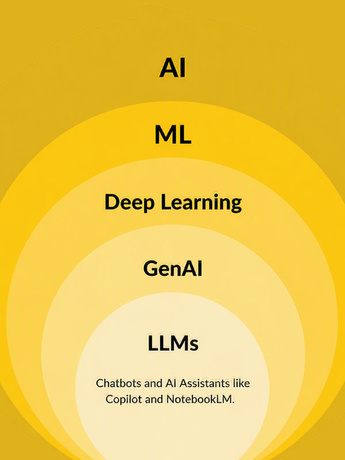
- Machine Learning (ML): A way to build AI by using algorithms that learn patterns from data. ML systems improve with more data.
- Deep Learning: A type of machine learning that uses layered systems (neural networks) to recognize complex patterns in data. It powers GenAI tools that create content like text, images or audio.
- Generative AI (GenAI): AI models that generate new content (like text, images or audio) by learning from large datasets. Open-source models (Llama 2, Stable Diffusion) allow developers to modify them, while closed-source models (ChatGPT, Gemini) restrict access to their parameters and training data.
- Large Language Models (LLMs): Advanced natural language processing (NLP) systems trained on massive text datasets, used for generating and analyzing content.
- Chatbots: Interactive systems that provide automated responses or assistance using conversational text.